Window replacement cost is often easier to estimate and budget for across the entire plan than for each window. For a house with 8 to 10 openings, published 2026 figures run from about $6,400 at the basic end to $22,000 or more. Zonda's 2025 Cost vs. Value Report prices a defined 10-window upscale vinyl project at $22,073, or roughly $2,207 per opening. Those are installed prices, not the price of a window off a shelf.
Those figures look like they contradict each other, but they don’t. The Zonda number reflects one set of upscale specifications, while the lower figures represent a basic specification. That’s why a price per window can be misleading until you know what’s included. If you already know the scope you want, our replacement window installation team can put figures against it.
*These figures come from Zonda's 2025 Cost vs. Value Report and Pella's published 2026 guidance, reviewed in August 2026. None of it is a quote, and Quality Exteriors sells and installs replacement windows, which you should know before weighing what we say about price.
Replacement Window Cost at a Glance
Below is a breakdown of the published figures we found, along with the assumptions behind each one, since those details can matter more than the dollar amounts themselves.
The $2,207 per-opening figure comes from dividing that job cost by ten defined openings, not an average of real invoices. The report publishes only national and regional averages, with Tennessee within its East South Central region, so there is no published figure for this market specifically, and no dataset of itemized Middle Tennessee estimates that we know of. A per-window price multiplied by your window count also breaks down once the house mixes styles, because one oversized picture window can cost more than four standard double-hungs.
What an Installed Price Covers
An installed price is a bundle, and what’s included in that bundle can vary by contractor. When two estimates for the same house differ by thousands, the difference in scope can explain more of the gap than the headline price alone suggests.

Finishing one opening takes the unit itself, then removal and disposal, opening preparation, air sealing, flashing, trim inside and out, paint on bare surfaces, a permit where required, and cleanup. Six of those routinely sit outside a quoted price rather than inside it, and each has a question attached:
- Trim, inside and out. Is casing included, is the exterior capped, and who paints it? An estimate silent on trim has not priced trim, and the carpentry becomes visible the moment the old unit is gone.
- Flashing. Is it included on a retrofit insert, where the crew never fully opens the wall?
- Disposal. Included, or a separate fee per opening?
- The permit. Who pulls it, and who pays the fee?
- A repair allowance. What is the rate if the sill is rotten, and what triggers it? This is the one that becomes a change order at an unset price when nobody names it.
- The warranty. Look past the word "lifetime" to what is excluded, whether labor is covered separately from the product, and whether coverage transfers when the house sells.
Our own warranty coverage is written out line by line for that last reason.
#cta_start
You Don’t Have to Become an Expert in Windows
That part is our job. Free quote, no obligation.
#cta_end
Retrofit Inserts Versus Full-Frame Replacement
This decision moves a price more than material choice does, and it is one of the harder parts of an estimate to evaluate before anything is removed.
A retrofit insert removes the sash and interior stops, leaving the existing frame and exterior trim in place. That keeps labor and trim work down, and it shrinks the glass area slightly, because two frames now stack in one opening. It’s the right answer when the existing frame is sound and square.
A full-frame replacement takes everything back to the rough framing, so the crew can see the sill, header, and flashing, and the glass area is preserved or gained. New trim is required inside and out, and the work runs 20 to 30 percent more, per Pella's cost guide. It’s the only answer when the frame has rot, the opening leaks, or the framing needs correction.
Neither method wins in the abstract. What should concern you is an estimate that names one method before anyone has looked at your openings, because that is a price quoted before a diagnosis.
Frame Material
Frame material sets a floor on price. These installed ranges come from Pella, the line we install.
Vinyl sits at the low end because the frames don’t require finishing. Fiberglass earns its premium through dimensional stability, since it expands and contracts at a rate close to glass. Wood offers a level of interior appearance and custom profiles that the others can’t match.
At $1,000 per window installed, the quote falls within the vinyl range and below fiberglass and wood, so the price isn’t necessarily high on its own. Material is also not the main cost driver: product line, glass package, hardware and installation quality often move a price further, which is why a premium unit set badly underperforms a mid-range unit set well.
Window Type
Style affects hardware, sealing, and crew time. Size affects almost everything else.
Size drives price on its own, which is why a single large picture window can exceed three standard double-hungs in the same house.
One code requirement is easy to miss. Glass near a stair, door, tub or floor may need to be tempered. That is a code question rather than a preference, and it adds cost at the openings where it applies.
Energy-Efficient Windows
Four things largely determine how a window performs: pane count, a Low-E coating, an inert gas fill such as argon, and frame construction. A fifth sits outside the product entirely: the air seal achieved at installation, and no specification compensates for getting that wrong. It’s why a well-rated window set poorly still feels drafty.
Tennessee falls in the South-Central climate zone, where the federal ENERGY STAR criteria set two numbers you can check on the NFRC label attached to the glass.
In this zone, the Solar Heat Gain Coefficient carries more weight than it does in northern states. As for what the upgrade returns, the climate zone modeling puts annual savings at $547 for replacing single-pane clear glass here, about 12% of a whole-home utility bill, and $336 for replacing double-pane clear glass, about 7%.
The widely quoted up-to-13% figure is the national single-pane number. For most homes built here in the last 30 years, the double-pane figure is more relevant. D+R International produced both estimates on a 2,376-square-foot two-story home.
The arithmetic follows from there. Against $6,400, the low end of the 8-to-10-opening range, a $336 annual saving is roughly a 19-year recovery. Against the upscale figure of $22,073, the same saving takes about 66 years. Utility savings alone aren’t usually enough to justify an upscale whole-home project, so if your existing units are sound, double-pane windows with intact seals, energy savings may be the weakest argument for replacing them. The stronger reasons are improved comfort near the glass, reduced condensation and noise, windows that no longer seal properly, and water getting into the wall.
One dated note on the tax credit. The federal Section 25C Energy Efficient Home Improvement Credit expired for property placed in service after 31 December 2025, per the IRS instructions for Form 5695. A 2026 window project does not qualify under current law, whatever older articles say. Check with a tax professional and your local utility for any current rebate.
How Long Do New Replacement Windows Last?
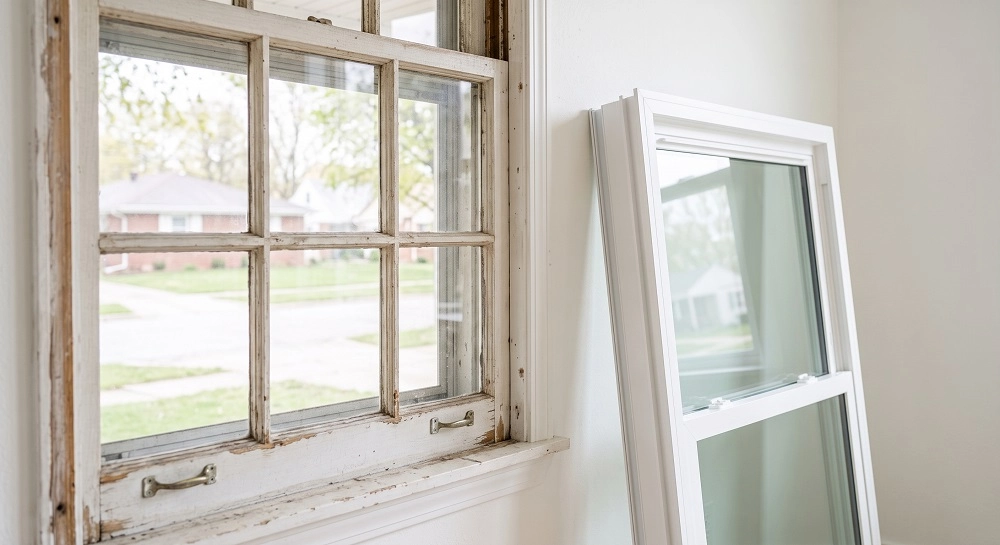
No single number tells the whole story, which is why published lifespans vary so widely. Service life depends on climate exposure, installation quality, and maintenance far more than the material itself, so a window in a dry, well-flashed opening can outlast the same window in a wet one. The window’s condition tells you more than age, and the type of failure tells you more than either.
Fog between the panes means the sealed glass unit failed, and the glass can often be replaced while the sash and frame stay. A sticking window usually needs hardware. A soft sill, or water inside the wall, is where full-frame replacement becomes the honest answer. Our guide on how to fix a drafty window covers the repair.
Do Replacement Windows Make a Difference to Home Buyers?
Resale treats windows more kindly than the utility math does. Zonda's 2025 Cost vs. Value Report puts upscale vinyl window replacement at 76% of cost recouped, returning $16,657 of the $22,073 spent. That ranks it above asphalt roof replacement at 68%, a midrange bath remodel at 80% on a far larger bill, and every kitchen project in the same report. Wood recoups 70%, or $18,764 of $26,781. These are estimates from surveyed real estate professionals across 119 markets for one defined project, not an appraisal of your house, and cost recouped isn’t money back in hand.
Contractor Licensing in Middle Tennessee
The project ranges above straddle the point where Tennessee's licensing requirement changes. Work from $3,000 to $24,999 falls under the state's Home Improvement license, which applies only in the nine counties that adopted the law, three of them in this service area. At $25,000 or more, a contractor's license is required statewide under the Contractors Licensing Act.
Verify requirements by county rather than by city, because some Middle Tennessee cities straddle county lines, and requirements can vary by parcel.