Where Permit Authority Actually Sits
The Tennessee Department of Commerce and Insurance runs a State Residential Building Code Enforcement Program for one- and two-family dwellings and townhouses. The rule applies only in jurisdictions that have not received an exemption from the State Fire Marshal’s Office or opted out through a two-thirds vote. Most populated parts of Middle Tennessee sit outside it, so the local codes department writes the rule that governs your roof.
Three layers decide the answer, and the middle one is where the differences appear.
- State framework. The baseline code edition, and the enforcement program covering jurisdictions without their own. Set by TDCI and the State Fire Marshal's Office.
- Local adoption. Which edition applies, which amendments apply, and whether a reroof needs a permit at all. Set by your city or county codes department.
- Project scope. Whether your job crosses that jurisdiction's threshold. Set by the work itself, including what turns up after tear-off.
Local codes departments do not all work from the same code edition. The state sits on the 2018 International Residential Code, unincorporated Williamson County enforces the 2021 IRC, Rutherford County's Board of Commissioners adopted the 2024 International Codes in May 2026, and Murfreesboro is on the 2018 building code.
Each edition treats repairs and exemptions differently, and each department adds local amendments on top. That produces different answers between neighboring counties.
Find the Office That Governs Your Address
Before addressing the permit requirements, you first need to determine which office has jurisdiction over your property. That office is called the authority having jurisdiction, and it isn’t always the city named in your mailing address.
Start with city limits. A property inside an incorporated city answers to that city's codes department, and a property outside every city boundary is unincorporated, which puts the county codes office in charge. Nashville is the exception, because Metro is a consolidated city and county government, so a Davidson County address reaches the same department either way.
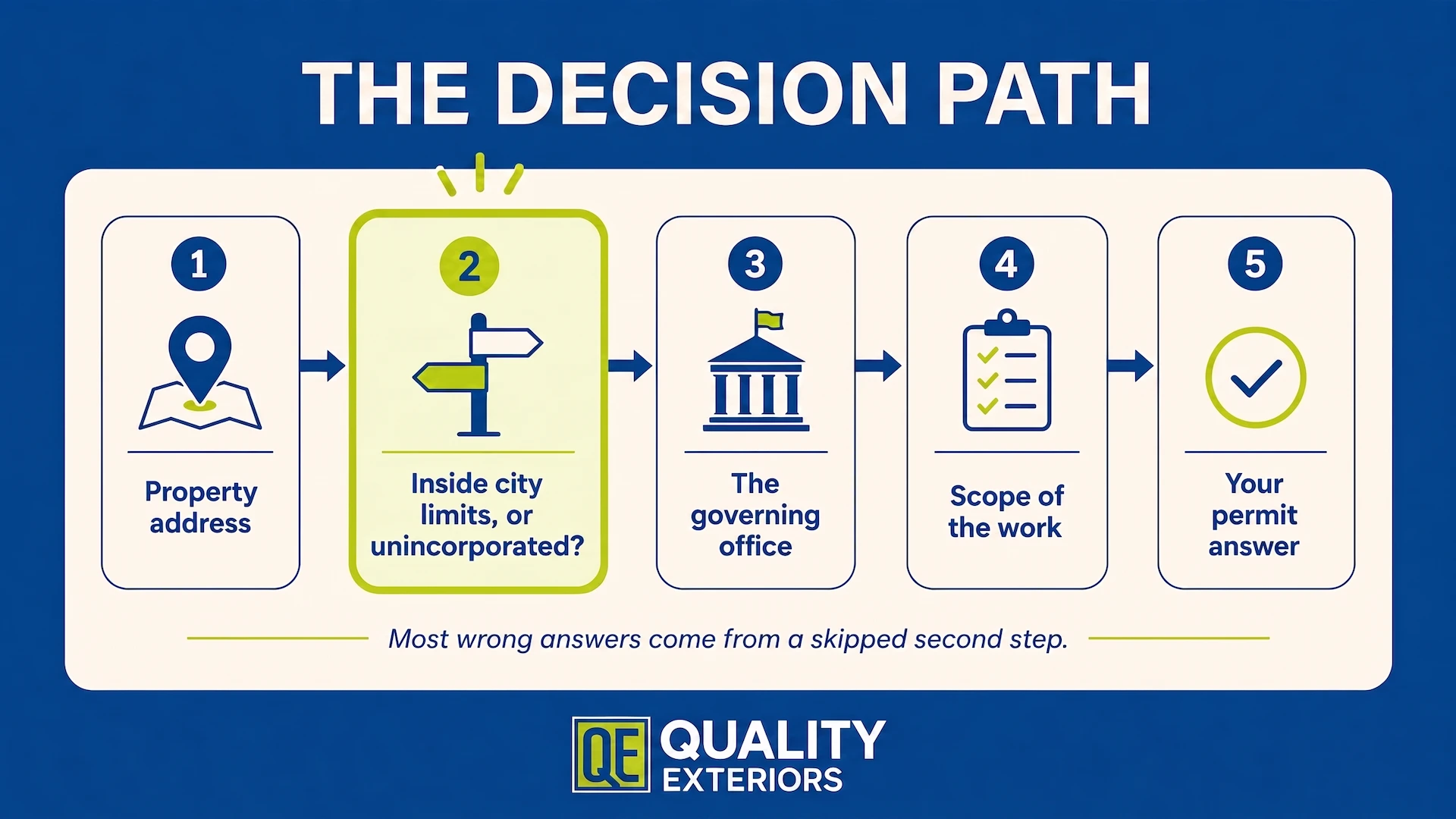
A mailing address, a ZIP code, and a school district can all point to a city with no authority over your roof. A Franklin mailing address can sit in unincorporated Williamson County, and a Murfreesboro one in unincorporated Rutherford County, which are opposite permit answers.
Your county property records or a call to either office settles it in minutes. Where a jurisdiction opted out of state enforcement or never ran a local program, the state program applies instead, and permits are bought through CORE at core.tn.gov or at a local Issue Agent.
What Counts as a Repair, a Replacement, and a Reroof
The line between a repair and a replacement is not a matter of wording. The rules vary by jurisdiction, so the same project can be subject to three different requirements in three Tennessee jurisdictions.
Nashville measures the area. Its normal maintenance exemption covers repairs up to 33 percent of the roof, so a full replacement sits outside it. Metro's rehab permit list makes the same point from the other direction, treating a new layer or more than a third of the roof as permit work.
Rutherford County measures structure instead, and its exemption holds only while reroofing leaves roof sheathing, rafters, and support beams alone. Unincorporated Williamson County treats a full replacement as an ordinary repair under IRC R105.2.2, so neither a permit nor an inspection applies, and the identical job inside Franklin city limits needs both.
Note the overlay row above, because a second layer is two questions rather than one. Layer limits and permit requirements are separate issues. Check both with your local authority instead of assuming that one automatically answers the other.
Scope can also change mid-job. Decking stays invisible until the shingles come off, so a reroof that qualified as exempt in the morning can cross a permit threshold by the afternoon. The proposal should therefore name who pulls the permit if that happens, which is also the cleanest way to keep a roof replacement estimate from drifting once the crew is on the roof.
A Permit Exemption Isn’t a Code Exemption
Williamson County's policy memo on roof repair and replacement is unusually direct about what an exemption does and does not remove.
The county's position, paraphrased: Exemption from the permit requirements does not authorize work that violates the code or any other local ordinance. Even with no permit and no inspection, the work must comply with adopted codes, including Chapter 9, Roof Assemblies, of the 2021 IRC. Roof assemblies and materials must also be installed according to the manufacturer's installation instructions.
Two consequences follow. An exempt reroof still has to meet code on underlayment, fastening, flashing, drip edge, and ventilation, and nobody from the county will be there to check. The standard doesn’t relax because the inspection went away.
Manufacturer requirements sit outside the permit question entirely. A permit isn’t the only thing that matters for your shingle warranty. Manufacturers typically require installation to follow their instructions, so improper nailing or inadequate ventilation can put coverage at risk even when no permit is required.
That is why the material specification in your proposal matters as much as the permit line. The right underlayment and flashing, specified in writing, protect you in exactly the jurisdictions where no inspector will.

Who Is Supposed to Pull the Permit?
In Tennessee, responsibility for the permit is set by statute rather than by preference.
The City of Franklin states it directly. If a homeowner hires a contractor, the contractor is required to be licensed and to obtain the permit, under Tennessee Code Annotated 62-6-103 and Board for Licensing Contractors Rule 0680-01-.22. Franklin also spells out why: a homeowner who pulls it on the contractor's behalf relieves that contractor of most liability and insurance obligations.
Rutherford County says the same thing in plainer language on its contractor guidance, telling homeowners that a licensed and reputable contractor will not ask them to pull their own permit. Two government offices give homeowners the same warning, and not because of paperwork. It’s about who carries the risk if the work fails inspection or causes damage.
A contractor who asks you to pull the permit is asking you to take on their liability. It belongs on the same list as the other questions worth asking upfront before any money changes hands.
Owner Permits, and Who They Are For
Owner permits exist for owners doing their own work. In Nashville, an owner who occupies or intends to occupy a single-family residence can pull what Metro calls a Self Permit. It takes a notarized Affidavit of Exemption plus a Self Permit Affidavit, and it puts full responsibility for code compliance on you.
The 24-month limit is state law rather than a local quirk. Under Tennessee Code Annotated 62-6-103, an individual may obtain only one property owner's permit in any 24-month period, which is why Franklin, Chattanooga and the state program all repeat it. None of it exists so a hired crew can work under your name.
#cta_here
What the Permit Costs, How Long It Takes, and What Inspectors Check
There is no statewide roofing permit fee in Tennessee, which means Nashville permit costs can vary. A flat dollar range may look helpful but can give homeowners a misleading sense of what they will actually pay. Metro charges a percentage of the job's value, so the fee moves with the size of your project instead of sitting at a fixed price.
Metro publishes the whole schedule in Metro Code 16.28.110. A residential permit is built from a valuation fee, a technology surcharge calculated from that fee, and a flat zoning examination charge, while one- and two-family permits are exempt from the plans examination fee and re-inspections are billed separately. Permit fees are based on the value of the improvement, not the size of the roof. Check with the Zoning Help Desk to confirm how your project will be valued.
Under the State Fire Marshal's program, the fee also follows estimated construction cost, and the first re-inspection is free while later ones carry a charge. Murfreesboro quotes fees only after the application has been reviewed, and Nashville's registered contractors file through ePermits. Most jurisdictions publish no turnaround figure at all, so ask yours rather than working from an assumption.
Two things to ask for: Your jurisdiction's current fee schedule, straight from the office rather than from a figure quoted elsewhere. And the permit shown as its own line in the proposal, rather than folded into a rounded estimate.
If inspections are required, the key deck inspection happens after the old roofing is removed but before the underlayment goes down, while the decking is still visible. A final inspection takes place after the work is finished. A failed inspection brings a correction notice rather than a penalty, and the contractor fixes the item and requests a re-inspection.
How to Tell a Legitimate Exemption from a Red Flag
Not every roofer who says no permit is needed is cutting corners. In unincorporated Williamson County, that answer is correct, and the county has published a memo saying so. The difference between a legitimate answer and a warning sign is specificity.
What License the Work Requires
Tennessee has no roofing-specific license, which is why the classification on a contractor's license matters. The Board for Licensing Contractors sets the thresholds by project value instead.
- $25,000 and up. A state contractor license. Roofing sits in the BC-21 classification, though BC, BC-A and BC-B also cover roofing work, so the absence of BC-21 on a license is not by itself a problem.
- $3,000 to $24,999. A Home Improvement license, but only in the nine counties that adopted the law: Bradley, Davidson, Hamilton, Haywood, Knox, Marion, Robertson, Rutherford and Shelby.
Williamson County is absent from that middle tier, and any license can be verified by number or name at verify.tn.gov before you sign. That absence has a practical consequence. A $20,000 reroof in unincorporated Williamson County sits below the state license threshold, outside the Home Improvement counties and outside the permit requirement at once, which leaves your written proposal as the only protection you have.
Manufacturer certification is a third, independent check, separate from the state license and from any local permit. Quality Exteriors holds GAF Master Elite® and GAF President's Club certification, which speaks to installation standards and warranty eligibility. A homeowner is entitled to ask for all three: the state license, the permit, and the certification.
Four Separate Approvals, One Roof
A building permit, a contractor license, an HOA approval, and an insurance authorization are four different things. Your roof may need all four, and clearing one of them does nothing for the other three.
The association is the one worth checking first. In some attached and planned communities, it controls or funds roof replacement outright, which means the first call may not be to a roofer at all.
If your property is in a historic overlay, you may face an additional design review on top of the building permit. Nashville and Murfreesboro each handle that review through a separate commission.
Insurance, Resale and the Records That Actually Matter
A missing permit rarely decides an insurance claim on its own. Coverage turns on your policy and the cause of loss, and those are settled long before anyone asks about a permit. What a missing permit takes away is your evidence: no permit number and no inspection record to hand the adjuster.
Resale works the same way. A missing permit is rarely an automatic obstacle to closing, because it is a proof problem rather than a legal one, and a buyer, an inspector, or a title search can question roof age, code compliance, warranty status, or concealed structural work. Nashville publishes a property permit history lookup, so you can verify a permit on your own property rather than taking anyone's word for it.
Keep one file on the job, whichever jurisdiction you are in. It is what answers a carrier, a buyer, or a future storm damage claim years from now:
- The permit copy, or written confirmation that none was required
- The final inspection record
- The signed contract showing scope, and the paid invoice
- Before and after photographs
- The warranty registration, with material and manufacturer details
What to Do If the Permit Was Skipped
A job that started without a confirmed permit is more recoverable than it looks. Work through the required steps in order, since only the first may be subject to a deadline.
- Pause before decking or structural work gets covered up. Concealed work is far harder to resolve than exposed work.
- Gather the contract, the proposal, any photographs, and the invoice.
- Ask for the permit number in writing. A real permit has a number, and an exempt job should come with a written explanation of why it is exempt.
- Call the office that governs the property and describe the scope accurately.
- Ask whether an after-the-fact permit or inspection is available for that scope.
Ensure you don’t skip step four. An accurate description of the work to a codes office is an ordinary inquiry, and many jurisdictions have a process for permitting or inspecting work after the fact.
Immunity is the one thing no honest source can promise. Rutherford County applies IRC R108.6 and charges a penalty equal to the building permit fee on top of the fee itself when work starts before a permit is issued, and other jurisdictions set their own penalty, so ask yours rather than assuming there is none.
The quieter cost is documentary. When a required permit was never obtained, there may be no permit number or final inspection record to provide a storm or when a buyer’s inspector reviews the property. Disclosure beats concealment, and it certainly beats discovering the gap during a sale.
Questions to Ask Your Roofer About Permits
Four questions settle the permit side of a roofing contract. Ask them before you sign, and get the answers into the proposal rather than taking them verbally.
- Ask which office has jurisdiction over your address. A good answer names a specific city or county department, not "Tennessee."
- Ask whether a permit is required for your scope, and who will pull it. A good answer describes your job accurately, as a full tear-off, shingles only, or a job that may reach the decking, and puts the contractor's name on the permit rather than yours.
- Ask what the permit costs and which inspections apply. A good answer quotes a fee from the jurisdiction's published schedule instead of a rounded guess.
- Ask what happens if the crew finds bad decking. A good answer is an authorization cap and a stated permit position, both written into the proposal before work starts.
Then put the answers in the contract. The wording below is for your own agreement, with any contractor.
The contractor will identify the authority having jurisdiction for the property, obtain any required building permit, and provide the permit number to the owner before work begins. The contractor will schedule all required inspections, correct any inspector-identified deficiencies at no additional cost to the owner, and deliver permit and final inspection records at completion. If no permit is required, the contractor will state in writing which jurisdiction governs the property and why the work is exempt.